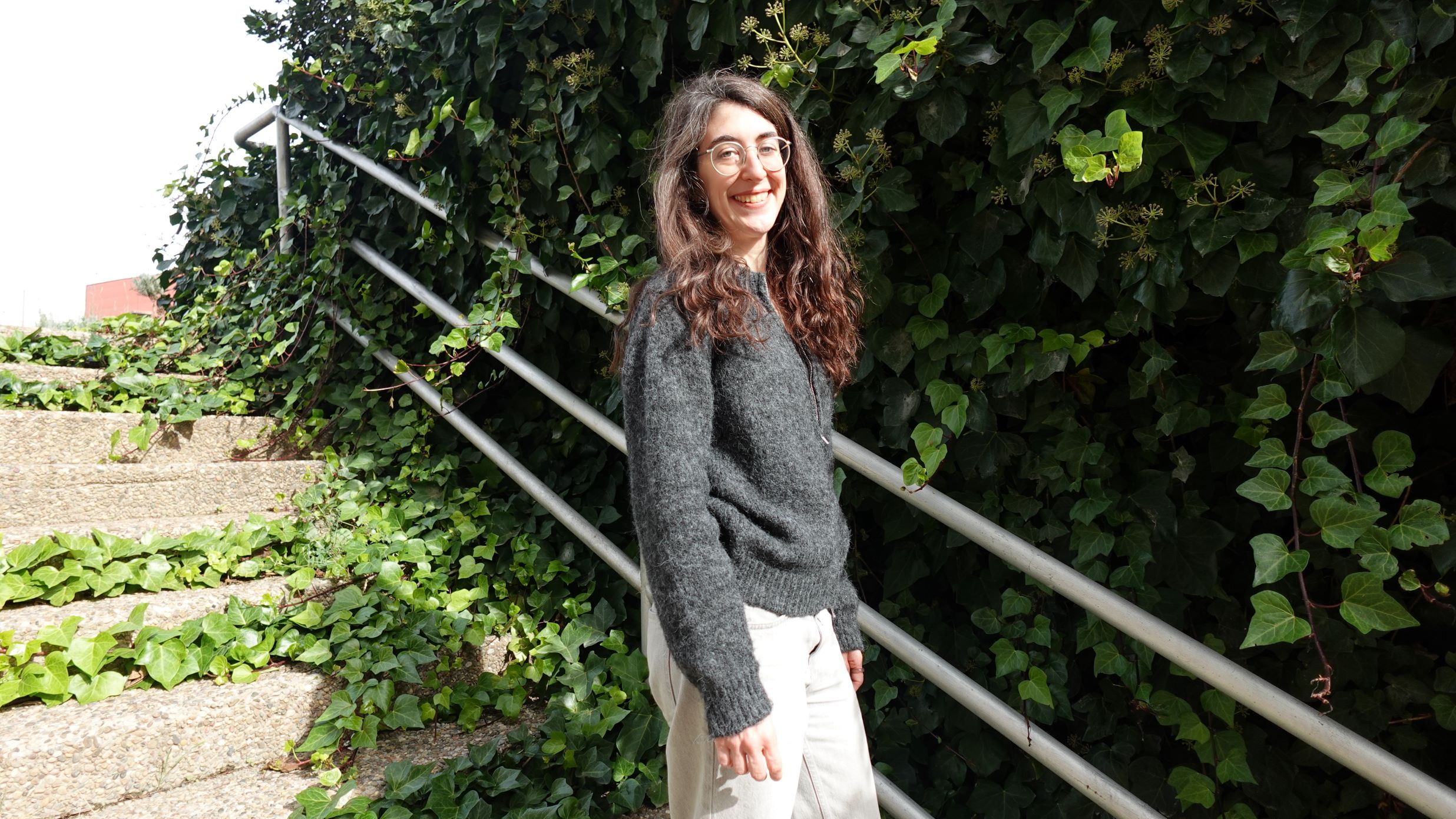
Alejandra Consejo, a researcher at I3A Unizar (Aragon Engineering Research Institute), has been selected to join the Young Academy of Spain, which has just elected its 10 new full members. An independent international committee comprising researchers from various fields of knowledge took part in the selection process. A total of 151 applications were submitted for this call. In addition to academic merit, other factors such as diversity and the multidisciplinary nature of their fields of work were taken into account.
Alejandra Consejo is a physicist with a PhD in Biocybernetics and Biomedical Engineering, and is passionate about understanding the human eye. She is a lecturer at the School of Engineering and Architecture (EINA) at the University of Zaragoza. She completed her PhD with a Marie Skłodowska Curie fellowship at Wroclaw University of Science and Technology (Wrocław, Poland) and has been conducting research into the human eye for over 10 years.
Among the awards he has received are the SAMCA Chair of Technological Development of Aragon Award for Multidisciplinary Innovation, the Unita Innovation Prize, the Young Research Talent Award at the Third Millennium Awards, the International Award for Young Doctoral Researchers presented by the Polish Academy of Sciences, and the EYRA (European Young Researchers’ Award) for the best PhD in Europe/best young researcher in Europe.
Last year, she was awarded one of the most prestigious grants from the European Research Council (ERC) to support VISIONSAFE, a project aimed at improving the early detection of eye diseases, which he will be developing over the next five years at the I3A. Through the ERC, he has received €1.5 million under the “Starting Grant” scheme. His proposal focuses on the use of medical imaging applied to macular degeneration, glaucoma, cataracts and corneal ectasia, using efficient, cost-effective and accessible tools.
The average age of the ten new Academicians is 36, and five women and five men have been selected. Their profiles span various fields of knowledge, including cellular ageing and senescence, the synthesis of functional polymers and 3D/4D additive manufacturing, artificial photosynthesis, ocular diagnosis using artificial intelligence, colorectal cancer bioengineering, molecular biophysical simulations, computational cognitive neuroscience, gene therapy, tumour metabolism and plasma physics.
In addition to Alejandra Consejo, the new full members of the Young Academy of Spain are: Carlos Anerillas Aljama (from the Aragonese Institute of Health Sciences), Patricia Altea Manzano, Alejandro Álvarez Laguna, Eva Blasco Pomar, Carla Casadevall Serrano, Luis Francisco Lorenzo Martín, Jorge Reñé Espinosa, Alejandro Tabas Díaz and Nerea Zabaleta Lasarte.
With his appointment, there are now three researchers from the I3A who are members of the Academy: the current president, Óscar Lucía, and Jaime Ibáñez, who was selected last year.
About the Spanish Youth Academy
The Young Academy of Spain was founded in 2019 by seven Spanish researchers who are members of the Global Young Academy. One of its distinctive features is that membership is limited to five years. This arrangement ensures that the 50 members of the academy (currently 47) remain young, with 10 new members joining each year to replace those whose membership expires that year.
Among its objectives are to promote science as a career choice amongst young people by highlighting exceptional young people from any country, and in particular from Spain, as role models; to promote scientific training; to serve as a forum and platform for young researchers in our country, giving them the opportunity to collaborate and help shape policies to promote knowledge; and to enable young researchers working abroad to become members of the Academy, acting as a link between these researchers and our country.
The Spanish Youth Academy It stands out for its multidisciplinary approach, bringing together professionals from fields as diverse as: computer science, engineering, archaeology, cultural anthropology, palaeontology, pharmacy, veterinary science, biology, chemistry, psychology, physics, European politics and culture, tourism, art history, dance, neuroscience, ecology, the environment, mathematics, artificial intelligence, sports science, linguistics, philology, food technology and philosophy.