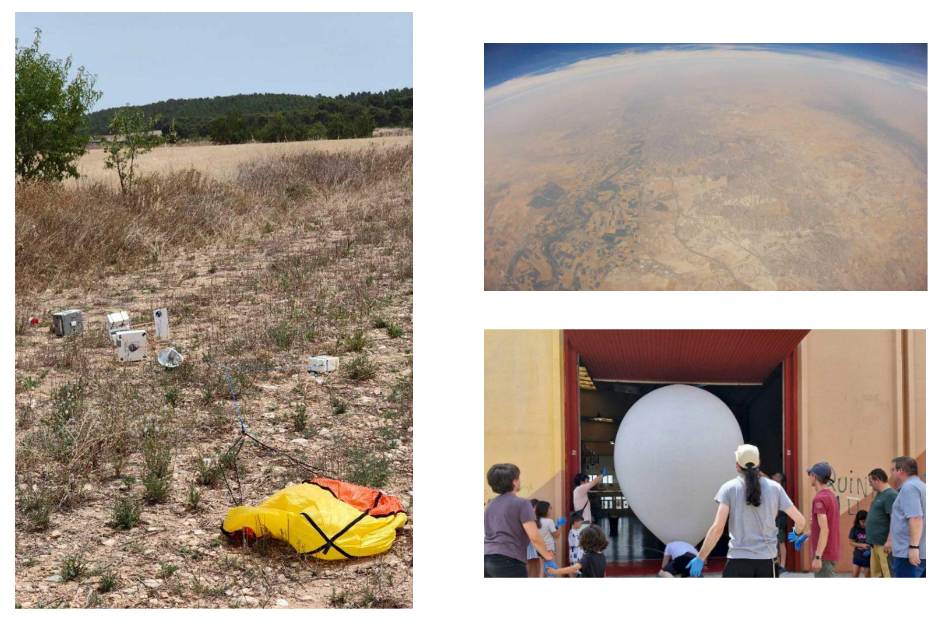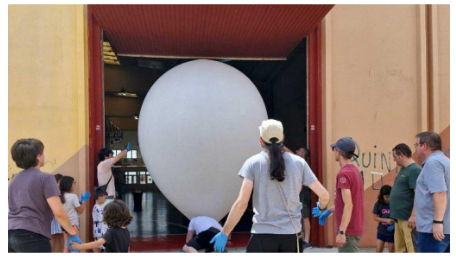
The launch took place from the Quinto sports hall at 12.34 pm. Schools, volunteers, technicians from partner organisations and local residents were involved in the preparations and launch, and watched closely as the balloon was inflated and released.
The communication and monitoring systems fitted to the balloon
The capsule carried several instrumentation and tracking systems on board: multiple APRS transmitters, LoRa devices connected to the TTN (The Things Network) network, cameras, a SPOT GEN3 tracker, and pressure and altitude sensors.
Results, distance travelled and balloon tracking via TTN
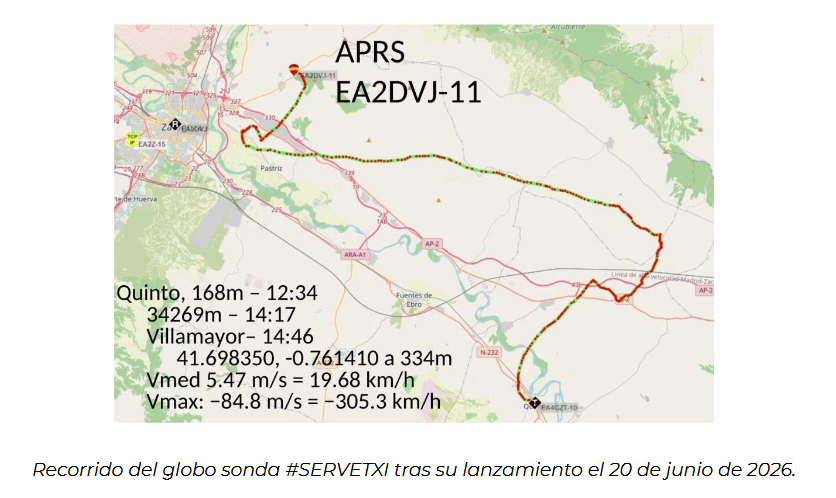
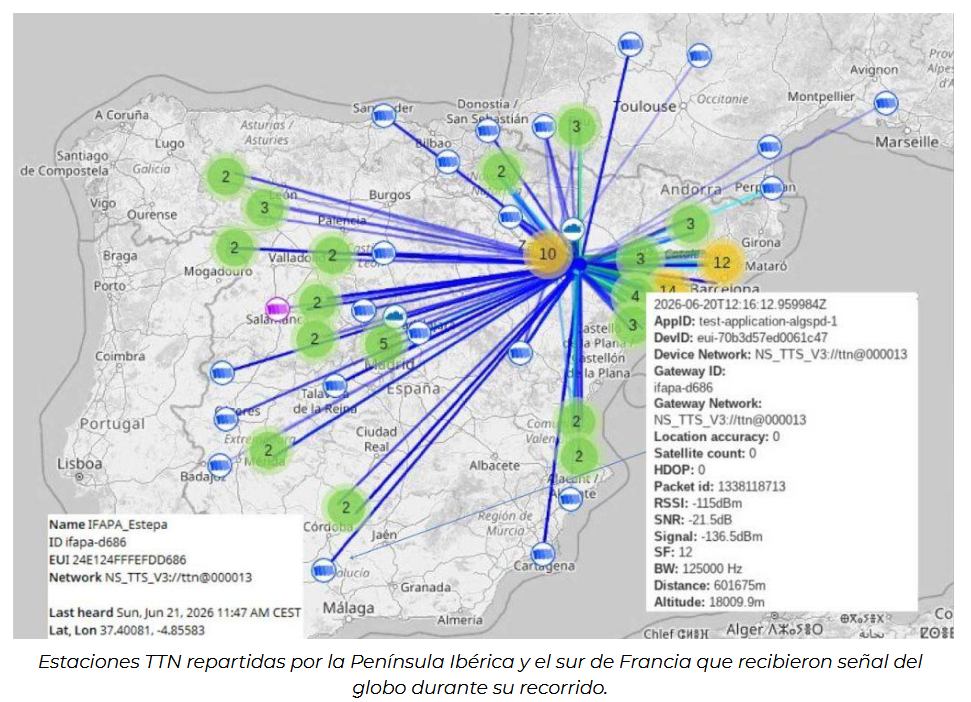
The balloon ascended at an average speed of 5.47 m/s, reached its maximum altitude of 34,269 metres at 14:17, and began its parachute-assisted descent. The maximum recorded descent speed was 84.8 m/s (equivalent to 305 km/h), which is typical during the phase of depressurisation and the bursting of the balloon. The capsule landed near Villamayor de Gállego at 14:46, in an agricultural area, and was recovered at coordinates 41.698350, -0.761410 at an altitude of 334 metres. Real-time tracking was carried out via various platforms, including predict.sondehub.org, and the signal was received by receivers distributed throughout the Iberian Peninsula, even reaching TTN gateways located in France and North Africa, which highlights the range of the LoRa network’s coverage at high altitudes.
The images captured during the flight show the curvature of the Earth as seen from the stratosphere, with the Ebro Valley and the surrounding mountain ranges visible on the horizon. Data on altitude, pressure and telemetry were recorded and are available for analysis.
The project #SERVET It forms part of the citizen science initiative in the stratosphere run by the I3A (University Institute for Engineering Research in Aragon) at the University of Zaragoza, in collaboration with the Ibercivis Foundation for communication and outreach, Teconecta for the technological aspect, and Quinto Town Council as the host organisation and for local logistical support.
Further information is available on the project website: https://servet.ibercivis.es/